
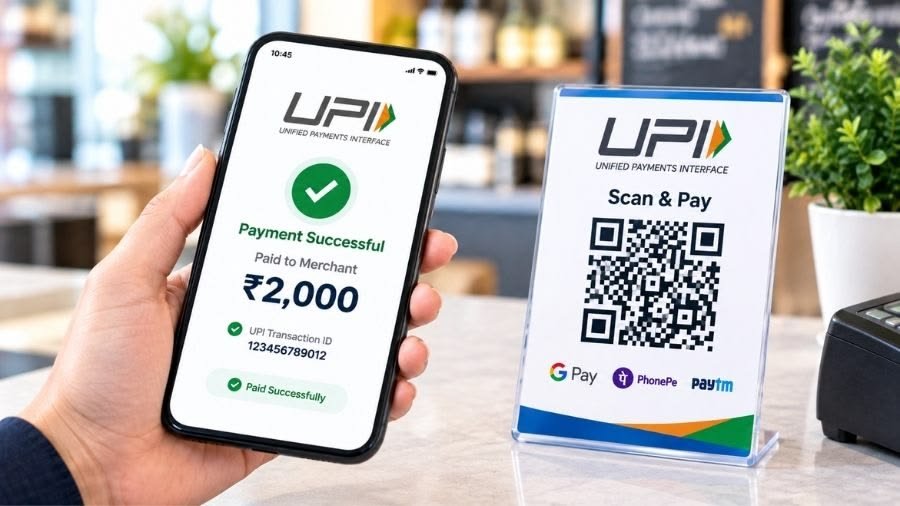
In today’s time, Consumers will not have to pay any extra charges or fees for UPI payments above ₹2,000 made through standard bank apps. Starting October 15, National Payments corporation of India (NPCI) guidelines ensure that regular users sending money via QR codes or online checkouts face zero surcharges. If you buy items worth more than ₹2,000, your bank account is debited by the exact invoice amount. The new rules protect everyday buyers from bearing any direct digital transaction fees.
The new rules introduce a Merchant Discount Rate known as MDR, which applies specifically to business owners rather than everyday shoppers. For standard merchant payments exceeding ₹2,000, businesses will pay a 0.4% processing fee. This fee is automatically deducted from the final settlement amount that goes into the merchant’s bank account. Government guidelines strictly prohibit shopkeepers and online sellers from passing this processing charge onto the customer.
To protect small businesses, the framework includes clear exemptions and strict caps on these backend fees. Small merchants collecting up to ₹1 lakh per month through standard UPI QR codes are completely exempt from paying any MDR. For larger transactions over ₹75,000, the fee is capped at a maximum of ₹300 per transaction so that large commercial purchases do not trigger massive costs. This design keeps the system affordable for local vendors while recovering infrastructure maintenance expenses from larger commercial entities.
Certain essential and high-volume sectors follow distinct fee structures under the updated 2026 policy. Categories like fuel, public utilities, railways, and insurance attract a flat ₹5 fee instead of the 0.4% rate for payments above ₹2,000. Meanwhile, capital market transactions involving mutual funds or stock purchases carry a minimal 0.02% charge. These targeted adjustments balance operational costs across different parts of the economy without disturbing everyday retail shopping.
Everyday peer-to-peer transfers and low-value retail purchases remain entirely free for all users across the network. Any money sent directly to family or friends via P2P UPI handles incurs no charges regardless of the transferred amount. Furthermore, merchant payments valued at ₹2,000 or below continue under a zero-fee structure. The ecosystem preserves its core convenience for small everyday needs while creating a structured foundation for commercial sustainability.
What Is the New UPI Charge Rule in 2026?
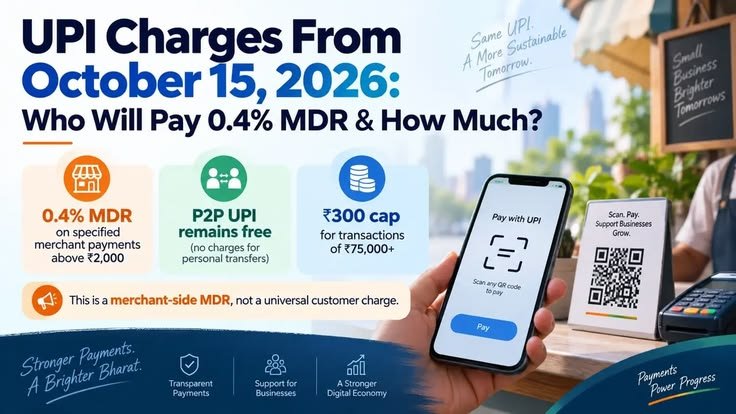
Starting on October 15, 2026, the National Payments Corporation of India (NPCI) and the Ministry of Finance are introducing a revised Merchant Discount Rate (MDR) framework for specific high-value Unified Payments Interface (UPI) transactions. The headline change is a 0.4% MDR levied on eligible Person-to-Merchant (P2M) payments exceeding ₹2,000. This represents a significant pivot from the zero-MDR policy implemented since January 2020, which originally aimed to spark absolute mass digital adoption. The core objective behind this regulatory change is to fund backend infrastructure, enhance cybersecurity, and establish long-term commercial sustainability for the digital payments ecosystem.
Crucially, everyday consumers will not face any direct UPI fees or surcharges under the new guidelines. The 0.4% processing fee applies strictly at the backend merchant settlement level. For instance, if you purchase a home appliance worth ₹10,000 using your standard bank-linked UPI app, you will pay exactly ₹10,000 out of pocket. The merchant’s bank handles the 0.4% calculation (which amounts to ₹40 in this scenario), deducting it from the payout the merchant receives. Banking institutions and payment service providers have been rigorously instructed not to permit merchants to pass this cost on to end consumers as a hidden or separate line item.
Effective October 15, 2026, a new Merchant Discount Rate (MDR) framework applies strictly to Person-to-Merchant (P2M) commercial transactions. Under this rule, a standard 0.4% MDR will be levied on eligible merchant transactions exceeding ₹2,000, with the fee capped at ₹300 for high-value transactions of ₹75,000 and above. This cost is borne entirely within the merchant payment ecosystem; banks and digital payment apps are strictly prohibited from passing these charges onto customers.
To protect small businesses and routine daily commerce, the rule includes extensive exemptions. Any merchant transaction of ₹2,000 or less remains free of MDR, which covers more than 95% of everyday UPI market volume. Furthermore, small neighborhood merchants under the P2PM category earning up to ₹1 lakh per month are completely exempt from these charges.
Will Customers Actually Pay for UPI Payments Above ₹2,000?

No, customers will not actually pay any direct fees for UPI payments above ₹2,000. The Ministry of Finance and the National Payments Corporation of India (NPCI) have explicitly clarified that the Unified Payments Interface remains completely free for consumers. Whether you are transferring money to a friend (Person-to-Person) or making a large purchase at a store, you will not see any additional transaction or platform fees added to your bill.
The confusion stems from a new policy taking effect on October 15, 2026, which introduces a 0.4% Merchant Discount Rate (MDR) on select Person-to-Merchant (P2M) transactions exceeding ₹2,000. This fee is strictly an ecosystem-level cost levied on relatively larger businesses to help banks and payment providers fund infrastructure, cybersecurity, and operational maintenance. Furthermore, small vendors generating less than ₹1 lakh per month and routine peer-to-peer transfers are entirely exempt from this framework.
While the government has legally prohibited businesses from passing this 0.4% fee on to consumers, there is a minor behavioral risk regarding how merchants react. Industry surveys, such as one conducted by Local Circles, indicate that if a merchant attempts to unofficially demand a surcharge to protect their margins on large bills, 76% of users would abandon UPI for that transaction, opting instead for cash or credit cards. However, in legitimate frameworks, customers remain fully protected, and the price of goods will stay identical regardless of the chosen payment method.
What Happens to UPI Payments Above ₹2,000?

On October 15, 2026, the National Payments Corporation of India (NPCI) is introducing a revised Merchant Discount Rate (MDR) framework for specified Person-to-Merchant (P2M) UPI payments exceeding ₹2,000. Under this update, a standard processing fee of 0.4% MDR will be levied on high-value retail business transactions, which is capped at ₹300 for massive payments of ₹75,000 or more.
everyday consumers face absolutely no direct fees or extra transaction costs for using UPI. Regular individuals transferring money to friends, family, or personal bank accounts—known as Person-to-Person (P2P) transfers—remain completely free regardless of the total amount. Furthermore, the government and the ministry of finance have explicitly barred merchants from passing this 0.4% processing fee onto buyers at checkout.
To protect the economy the revised rule features a zero-MDR exemption for eligible small vendors. Small businesses, street vendors, and local shops that operate under the P2PM category and collect up to ₹1 lakh per month through their UPI QR codes will continue to process all high-value transactions completely free of charge. Statistics show that roughly 96% of all retail digital payments stay safely under the ₹2,000 threshold, leaving the vast majority of small businesses unburdened.
Which Businesses and Transactions Are Affected?

Businesses and transactions are affected universally whenever new regulatory frameworks, tax policies, or economic shifts are introduced. In terms of affected businesses, the impact spans across all legal structures, including sole proprietorships, partnerships, limited liability companies (LLCs), and major corporations. While small businesses often feel a disproportionate burden due to limited compliance resources, multinational corporations face complex cross-border adjustments, such as tracking transfer pricing and adhering to varying international tax codes. Highly regulated sectors—including banking, insurance, healthcare, and digital services—frequently experience the most immediate disruptions when standards evolve.
When evaluating affected transactions the impact is categorized by how capital and operational agreements are structured. Core operating transactions, which involve day-to-day activities like purchasing goods from suppliers, selling services to customers, and paying routine business expenses, are directly altered by changes to sales taxes or operational mandates. Meanwhile, investing and financing transactions—such as securing bank loans, issuing equity, purchasing long-term machinery, or modifying existing debt terms—are highly sensitive to shifting interest rates and corporate finance laws.
Finally, the mechanisms of payment execution play a major role in how these disruptions ripple through an enterprise. Cash and credit transactions generate different timeline liabilities, meaning that sudden regulatory changes can instantly trap working capital or alter receivables. Concurrently, compliance and internal transactions, such as processing employee payroll, accounting for asset depreciation, and managing mandatory tax filings, must be rapidly reconfigured to avoid severe legal and financial penalties. Ultimately, a business’s capacity to audit and adapt both its operational and financial workflows determines its long-term stability during regulatory transitions.
Will UPI Become More Expensive for Indians?
Not at all, UPI will not become directly more expensive for individual Indian consumers. Everyday digital payments remain completely free. The National Payments Corporation of India (NPCI) and the Ministry of Finance have explicitly stated that individual users do not face any transaction fees, platform charges, or monthly quotas for sending money or making regular purchases.
The recent shift in the rules concerns the implementation of a 0.4% Merchant Discount Rate (MDR). This processing fee is levied on commercial entities for specified transaction values exceeding ₹2,000. Certain major sectors like fuel, telecom, insurance, and railways instead attract a flat ₹5 MDR on transactions above that same limit. This fee does not apply to small vendors who earn up to ₹1 lakh per month, nor does it impact payments under ₹2,000, which make up about 96% of all merchant transactions.
Crucially, businesses are legally prohibited from passing these MDR costs down to the consumer. Banks and payment apps are closely monitoring transactions to prevent merchants from adding a surcharge or extra checkout fees. All person-to-person (P2P) transfers—like splitting a dinner bill, sending money to family, or wire transfers between your own accounts—remain entirely outside of this framework and cost nothing.
Conclusion
The new UPI framework does not mean that Indians will suddenly have to pay a fee every time they use UPI. UPI payments between individuals remain free, and customers are not directly charged MDR. The new MDR primarily applies to specified merchant transactions above ₹2,000, while the vast majority of merchant transactions remain unaffected.
For consumers, the best approach is to continue using UPI normally while staying informed about changes in UPI new rules, merchant charges and digital-payment policies. As UPI continues to grow, understanding how these changes work can help users make smarter financial decisions.